| Quick Summary |
|---|
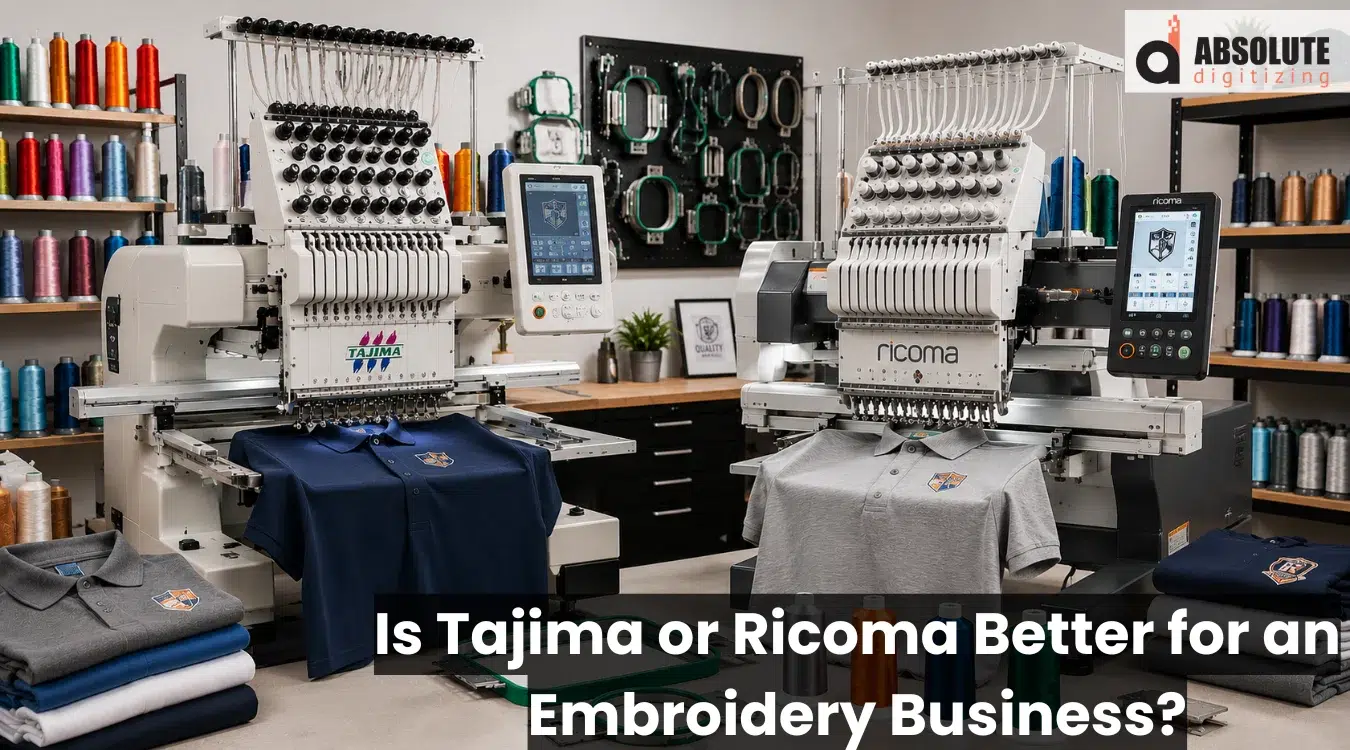
Tajima and Ricoma suit different embroidery businesses, budgets, and production goals.
|
Choosing between Tajima and Ricoma can feel confusing, especially when both brands offer machines for commercial embroidery. Each brand has strong points, but the better choice depends on your budget, workload, experience, and long-term goals.
Tajima often suits busy embroidery shops that need strong build quality, steady production, and advanced stitch control. However, Ricoma may work better for new business owners who want training, financing, and an easier setup process.
Still, the machine alone does not control the final result. Clean digitizing, proper hooping, the right stabilizer, and regular maintenance all affect stitch quality.
Absolute Digitizing delivers the best embroidery digitizing services for Tajima, Ricoma, and all other machines. As a result, your designs can run with fewer thread breaks, sharper detail, and more consistent results across every order.
- Quick Answer: Tajima or Ricoma?
- Tajima vs Ricoma at a Glance
- Insights From a Facebook Embroidery Group
- What Types of Embroidery Machines Do Tajima and Ricoma Offer?
- Which Brand Produces Better Embroidery Quality?
- Which Embroidery Machine Offers Better Speed and Production Capacity?
- Which Brand Is Easier for Beginners to Use?
- Which Embroidery Machine Is More Reliable for Long-Term Use?
- Which Brand Offers Better Training, Support, and Warranty Coverage?
Quick Answer: Tajima or Ricoma?
Tajima usually suits established shops that need steady output and room to expand.
Who Should Choose Tajima?
- Established embroidery businesses
- Shops with heavy daily production
- Users who need advanced stitch control
- Companies planning industrial growth
- Buyers focused on long-term machine use
However, Ricoma often provides an easier path for new and growing businesses through financing, training, technical support, and machine packages.
Who Should Choose Ricoma?
- New embroidery business owners
- Buyers who need financing
- Users who value included accessories
- Owners who want ongoing training
- Small custom apparel shops
Still, neither brand wins in every situation. Compare similar machine classes. For example, compare two commercial single-head models instead of an entry machine with an industrial system. Tajima offers compact SAI, single-head, multi-head, flat-bed, and specialty machines.
Tajima vs Ricoma at a Glance
Both brands serve commercial embroiderers. However, they support different business needs.
| Comparison Area | Tajima | Ricoma |
|---|---|---|
| Best suited for | Established, high-output shops | Startups and growing businesses |
| Machine range | Industrial and specialty systems | Beginner to multi-head machines |
| Learning support | Often depends on the dealer | Direct training and technical support |
| Buying structure | Packages vary by distributor | Often sold in bundled packages |
| Financing | Depends on the regional dealer | U.S. financing for approved buyers |
| Technology | i-TM, DCP, and production systems | Touchscreen controls and software options |
| Warranty | Varies by seller and region | U.S. coverage reaches five years |
| Main strength | Industrial production | Easier business entry |
Tajima’s warranty coverage usually depends on the machine model, country, and authorized distributor.
Meanwhile, Ricoma’s U.S. warranty covers non-consumable parts and labor for one year, electronics for three years, drivetrain parts for five years, and technical support for life.
Features, prices, accessories, and coverage vary by country. Therefore, request a written quote and complete warranty terms before ordering.
Insights From a Facebook Embroidery Group
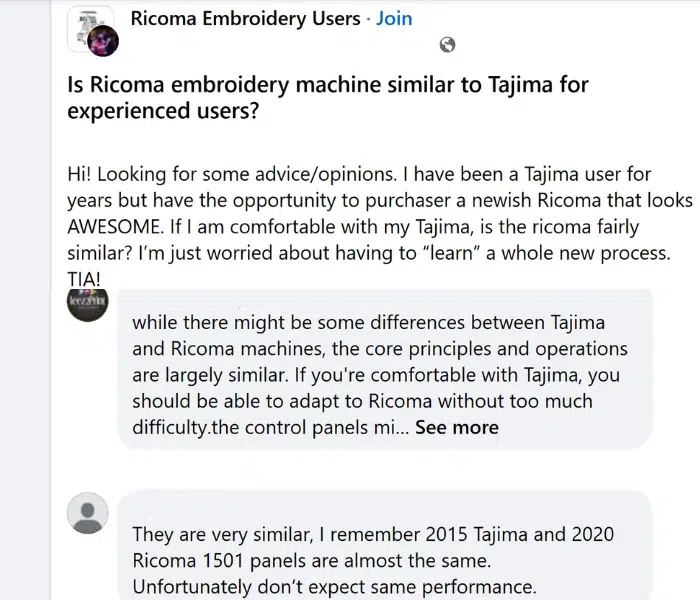
Experienced Tajima users shared their views in a Facebook embroidery group. Some said the basic controls and operating steps feel similar, so switching to Ricoma may not require a complete relearning process.
However, others noted that similar controls do not always mean the same production performance.
This feedback is useful, but it remains personal opinion rather than a technical test. Therefore, buyers should try the exact machine before purchasing and compare controls, stitch quality, and support.
What Types of Embroidery Machines Do Tajima and Ricoma Offer?
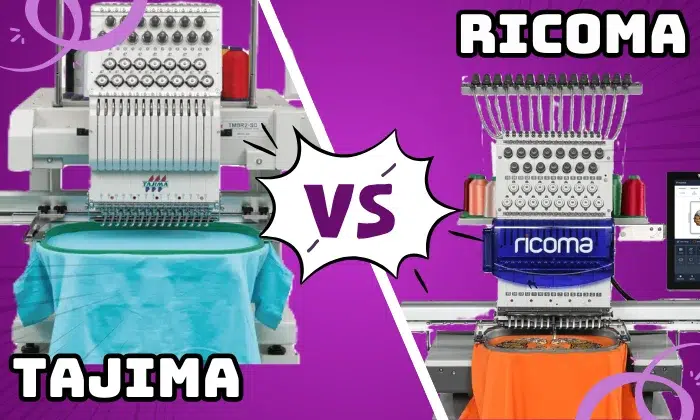
Both brands offer embroidery machines for different production levels. However, their product ranges are not identical.
What Machines Does Tajima Offer?
Tajima provides a broad commercial lineup, including:
- Compact entry machines
- Single-head cylinder models
- Multi-head cylinder systems
- Multi-head flat machines
- Chenille and specialty equipment
- Production and digitizing software
Their current single-head range includes the compact SAI, standard TMBP2-SC, high-end TMBR2-SC, and flagship TMEZ-SC. Tajima also offers flat-bed, multi-head, chenille, taping, and specialized industrial systems.
What Machines Does Ricoma Offer?
Meanwhile, Ricoma serves beginners, custom apparel startups, and larger production shops. Their range includes:
- Compact 10-needle machines
- Commercial single-head models
- Multi-head embroidery systems
- Machines for caps, garments, and flat items
- Touchscreen control systems
- Chroma digitizing software options
Current regional models include the EM-1010, Creator, Swift, Marquee, Titan, and CHT2 series. However, model names, needle counts, and availability can differ by country.
Therefore, compare machines by class and workload. A compact 10-needle unit does not serve the same purpose as a full-size 15-needle industrial system.
Which Brand Produces Better Embroidery Quality?
Tajima often has an advantage in advanced stitch control and demanding production. However, both brands can create clean, professional embroidery with the right setup and digitized file.
What Affects the Final Stitch-Out?
A good machine should provide:
- Accurate design registration
- Stable thread tension
- Clean small lettering
- Smooth satin columns
- Even fill coverage
- Reliable cap performance
- Fewer thread breaks
- Less fabric movement
- Consistent results across repeat orders
Tajima’s flagship TMEZ-SC uses Intelligent Thread Management and a Digitally Controlled Presser Foot. These systems adjust upper thread supply and presser-foot pressure based on fabric thickness and stitch conditions. As a result, they reduce manual adjustments and help control fabric movement. The machine reaches up to 1,200 rpm under suitable conditions.
Meanwhile, Ricoma machines can also produce professional work when operators set the tension, hooping, and cap frame correctly.
Still, machine quality alone does not decide the result. Digitizing, stabilizer, thread, needles, maintenance, hooping, and operator skill all affect registration and coverage.
Therefore, differences often become clearer during long runs, cap orders, material changes, and repeated commercial production.
Which Embroidery Machine Offers Better Speed and Production Capacity?
Tajima lists the TMEZ-SC and TMBR2-SC at speeds of up to 1,200 rpm. However, the standard TMBP2-SC reaches up to 1,000 rpm. Ricoma’s Titan multi-head systems also list speeds of up to 1,000 stitches per minute.
Still, maximum speed does not equal real production output.
What Controls Daily Production?
- Stitch length and design density
- Number of trims and color changes
- Thread breaks and machine stops
- Cap framing and hoop setup
- Loading and unloading time
- Operator experience
- Number of machine heads
Therefore, a slower machine with fewer stops may finish more sellable items than a faster model that needs constant adjustments.
Is Single-Head or Multi-Head Production Better?
A multi-head machine stitches the same design on several garments at once. For example, Ricoma’s Titan range offers four to twelve heads for repeated bulk orders.
Meanwhile, several single-head machines can run different designs at the same time. This setup often gives custom shops more flexibility for small and mixed orders.
Which Brand Is Easier for Beginners to Use?
Ricoma may feel easier during the buying and learning stage. The company offers beginner-focused machines, training sessions, video tutorials, maintenance guides, and direct technical support. As a result, new owners can get help with threading, tension, hooping, caps, and basic machine use.
However, newer Tajima machines also reduce the learning curve. The TMEZ-SC includes a 12.1-inch touchscreen, design-position controls, Intelligent Thread Management, and a digitally controlled presser foot. These features reduce manual adjustments and make complex production easier to manage.
Which Option Feels Easier?
- Ricoma may offer a smoother training experience.
- Tajima can simplify advanced machine control.
- Local dealer support can affect both experiences.
Therefore, request a live demonstration before buying. Test caps, polos, small lettering, and your own digitized files to see which system feels easier to operate.
Which Embroidery Machine Is More Reliable for Long-Term Use?
Long-term reliability depends on how well a machine handles the shop’s daily workload. Tajima has a long record in commercial embroidery, but brand reputation alone does not guarantee trouble-free operation.
Meanwhile, Ricoma can serve small and growing businesses well. However, buyers should match the exact model to their expected workload and confirm who handles warranty repairs.
What Factors Affect Machine Reliability?
- Daily operating hours
- Frame stability during fast sewing
- Machine age and service history
- Access to replacement parts
- Local technician experience
- Regular cleaning and lubrication
- Heat, dust, and humidity
- Care from a previous owner
In addition, local parts and technician access can greatly affect downtime. A dependable machine becomes less useful when repairs take weeks.
Therefore, compare maintenance needs, warranty duties, parts supply, and nearby service before buying any embroidery machine. For used equipment, condition and service records may matter more than the brand name.
Which Brand Offers Better Training, Support, and Warranty Coverage?
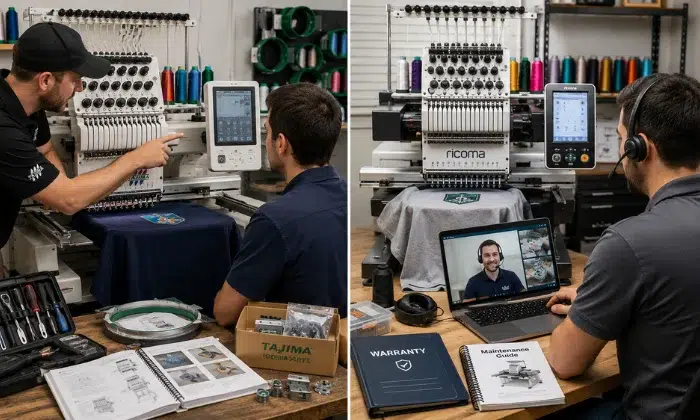
Support can affect machine ownership as much as speed or stitch quality. Therefore, buyers should study the full service package before ordering.
What Support Does Ricoma Provide?
Ricoma offers direct customer support, training videos, setup guides, and business-startup resources. In the United States, new embroidery machines include a limited five-year warranty and lifetime technical support.
However, each part has a different coverage period:
- Parts and technical labor for one year
- Electronic parts for three years
- Drivetrain parts for five years
- Technical support for the machine’s life
The U.S. warranty is non-transferable, and some on-site travel costs may not be covered. Terms also vary by country.
How Does Tajima Support Their Customers?
Tajima works through many distributors worldwide. Local dealers may handle installation, training, maintenance, parts, and repairs. As a result, service quality and warranty terms can differ by location.
What Should Buyers Ask?
- Is installation and on-site training included?
- Who handles warranty repairs?
- Are technician travel costs covered?
- Are replacement parts stocked locally?
- Is remote support free?
- Does the warranty transfer to another owner?
What Is the Total Cost of Owning a Tajima or Ricoma Machine?
The machine price is only one part of the total investment. Costs can change based on the model, needle count, number of heads, accessories, cap system, stand, hoops, software, shipping, installation, training, promotions, financing, and country.
Ricoma often promotes financing for qualified U.S. buyers. In addition, some packages may include hoops, cap attachments, training, software, or business tools. Tajima pricing usually comes through authorized distributors, so package contents and service costs can vary by dealer.
What Costs Should You Calculate?
- Machine purchase price
- Interest and financing fees
- Shipping and installation
- Training and embroidery software
- Hoops and cap frames
- Routine maintenance
- Replacement parts
- Technician travel
- Production downtime
- Future resale value
Therefore, request written quotes with the same equipment and support included. This makes comparison easier and prevents surprise costs.
Which Brand Offers Better Embroidery Software and File Compatibility?
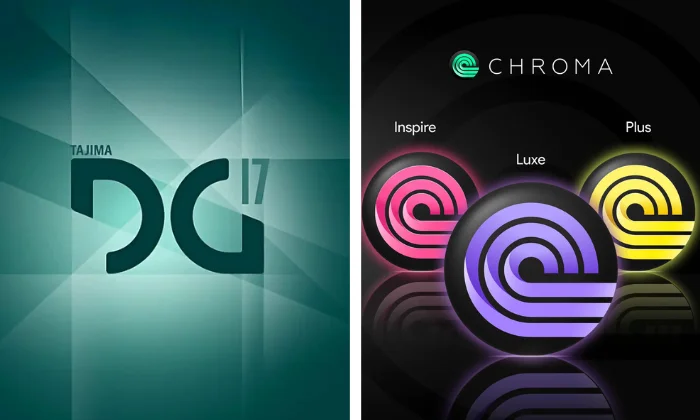
Tajima supports commercial production with software products such as DG, PulseID, PulseLQ, and other workflow tools.
Meanwhile, Ricoma offers Chroma digitizing software in several levels for basic editing and full design creation.
Both brands can run common machine-ready formats when the selected model supports them.
However, software and machine choice should stay separate. A strong machine cannot fix a poorly prepared embroidery file. Auto-converting a logo into DST or another format does not complete the embroidery digitizing process.
What Should a Quality Stitch File Control?
- Stitch type and underlay
- Density and pull compensation
- Stitch direction and order
- Trims and color changes
- Fabric movement and coverage
Therefore, each design should match the fabric, size, placement, and machine setup. Absolute Digitizing prepares clean stitch files that help Tajima, Ricoma, and other commercial machines run more smoothly.
Which Machine Is Better for Different Buyers?
The better choice depends on your experience, order volume, budget, and access to local service. Therefore, match the machine to your business needs instead of choosing by brand reputation alone.
| Buyer Type | Better Starting Choice | Main Reason |
|---|---|---|
| First-time embroidery business | Ricoma | Training, financing, packages, and beginner support |
| Established commercial shop | Tajima | Advanced controls and strong production systems |
| Home-based seller expanding | Ricoma | More approachable path into commercial work |
| High-volume uniform producer | Tajima | Multi-head options for repeated bulk orders |
| Shop wanting a complete package | Ricoma | Bundled accessories, software, and business tools |
| Buyer seeking advanced thread control | Tajima | i-TM and DCP on selected models |
| Used-machine buyer | Depends | Condition, age, service records, and parts access |
| Rural buyer | Depends | Choose the brand with nearby technical support |
However, this table should guide your research rather than replace a machine test.
Local support can outweigh small differences in machine specifications. A machine that receives fast repairs may offer more value than a stronger model with no nearby technician.
Final Verdict: Which Brand Should You Choose?
Tajima is often the stronger choice for established shops, heavy production, and advanced stitch control. Meanwhile, Ricoma may suit beginners and growing businesses that value training, financing, bundled accessories, and direct support.
However, the best machine depends on your workload, budget, local technician access, and long-term plans. Therefore, compare similar models, review the full warranty, and test each machine with your real products before buying.
No machine can fix a poorly prepared design. For clean registration, smooth runs, and fewer production issues, contact Absolute Digitizing for professional machine-ready embroidery files. Upload your artwork today and get a free quote.
FAQs
Tajima is generally better for high-volume commercial production and advanced machine control. Ricoma may be better for beginners who value financing, bundled equipment, training, and direct support.
Yes. Ricoma sells commercial single-head and multi-head embroidery machines. Results depend on the selected model, design quality, machine setup, maintenance, and operator skill.
Ricoma may offer an easier starting path for a new small business. However, Tajima may provide stronger long-term value for shops expecting heavy production and future expansion.
Both brands offer machines and cap attachments. Compare cap-frame stability, sewing field, realistic cap speed, registration, technician support, and stitch results on the exact cap styles you sell.
Older industrial machines may require more operator knowledge. However, newer Tajima models include touchscreens and automated technologies designed to reduce manual adjustments.
A used Tajima may be valuable when it has a strong service history and local technician support. A new Ricoma may offer easier training and warranty coverage. Inspect total cost and machine condition before deciding.